This question comes up on almost every deck job. Both materials build a good deck. They fail differently, age differently and suit different owners.
How they compare
| Factor | Timber | Composite |
|---|---|---|
| Appearance | Natural grain, changes over time | Consistent, uniform, less variation |
| Upfront cost | Lower for treated pine, mid for hardwood | Generally higher |
| Ongoing maintenance | Regular cleaning and recoating | Cleaning, no coating |
| Surface heat in full sun | Cooler than most composites | Can get hot in direct summer sun |
| Scratching and marking | Sands back and recoats | Surface damage is harder to repair |
| Longevity | Long with maintenance | Long with little intervention |
| Feel underfoot | Timber, with natural movement | Uniform, slightly denser feel |
| Repairs | Individual boards easy to replace and blend | Board replacement can be visible if the batch has aged |
The real question: maintenance
Timber looks its best when it is looked after. That means washing it and recoating on a cycle that suits its exposure. A deck in full northern sun near the coast needs attention more often than a shaded deck.
If you enjoy that work, or you will pay someone to do it, timber is excellent. If you know you will not touch it for five years, composite will look better for longer, because timber that is never coated greys off and can check and splinter.
That is the honest deciding factor for most households. Have a look at our deck maintenance guide for Sydney homeowners and decide whether that schedule sounds like you.
Where timber wins
- Hardwood has a depth and variation composite does not replicate
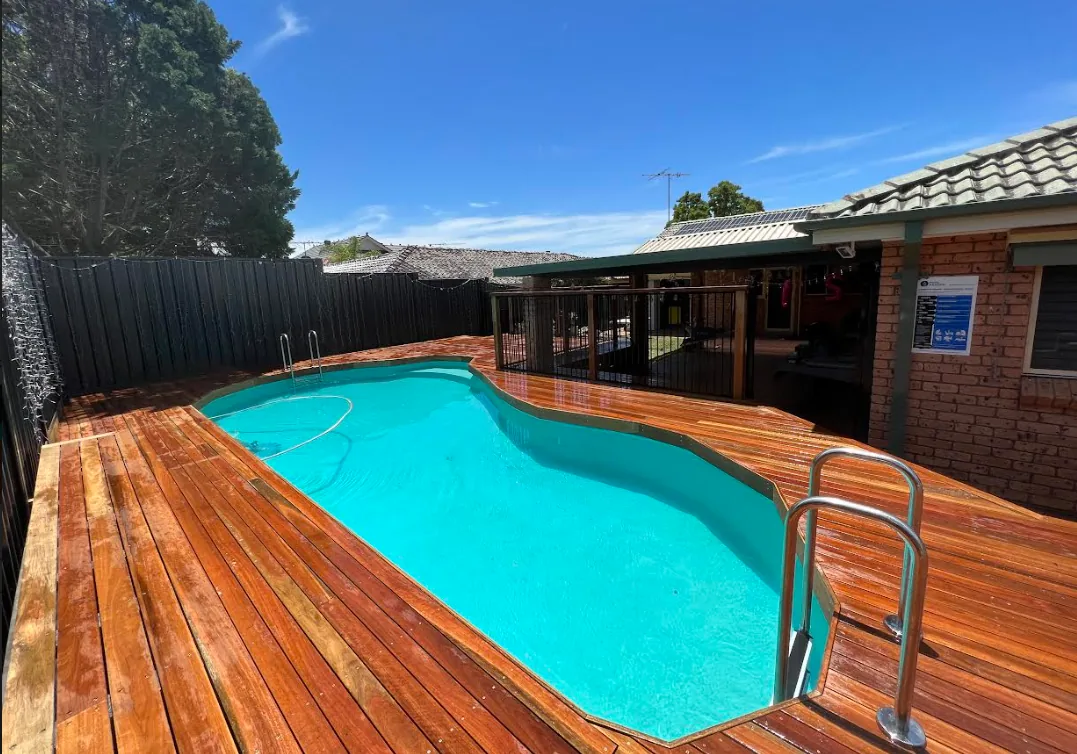
- Cooler underfoot in full sun, which matters for a deck used barefoot around a pool
- Damaged areas can be sanded and recoated rather than replaced
- Better suited to heritage and traditional homes where the look matters
- Individual boards are simple to swap out
Where composite wins
- Consistent appearance without coating
- No splintering, which some families prefer around young children
- Good for decks that are hard to access for maintenance, such as high or narrow ones
- Stable width and thickness, with less movement between boards
- Colour retention over time on quality products
Things people get wrong
- Assuming composite is maintenance free. It is low maintenance. It still needs washing, and mould grows on any surface in a damp, shaded spot.
- Ignoring the substructure. Both materials sit on the same framing, and the framing determines whether the deck lasts. Joist spacing requirements differ between products, so check the manufacturer requirements before framing.
- Buying on price alone. Cheap composite products vary a lot in quality. So does cheap timber.
- Forgetting heat. Dark boards in full sun get hot regardless of material, and darker composites more so.
- Using the wrong fixings. Near the coast, hardware specification matters as much as the boards.
Cost over time
Timber is usually cheaper to build and costs something to maintain. Composite costs more to build and less to maintain. Over a long life the totals often end up closer than the initial quotes suggest, so choose on the basis of appearance and how you will use the deck rather than assuming one is clearly cheaper.
For build pricing, see how much it costs to build a deck in Sydney.
Our practical take
For a deck used around a pool, barefoot in summer, on a home where the owner likes natural materials, quality hardwood is hard to beat. For a busy family deck that nobody wants to sand and recoat, or a deck that is difficult to reach, composite is a sensible choice.
If you want hardwood, the species matters. The best timber for a deck in Sydney covers the common options.
Questions that settle the decision
- Will you maintain it? Answer this honestly, not aspirationally. It decides more than any other factor.
- Will it be used barefoot? Around a pool, surface temperature and comfort matter.
- How exposed is it? Full northern or western sun is hard on coatings and on dark boards.
- How easy is it to access for maintenance? A high deck over a slope is a different proposition to a low deck you can walk around.
- What is the house made of? A timber deck usually sits more comfortably against a weatherboard cottage than a uniform grey board does.
- How long do you plan to stay? Composite holds its appearance with less intervention over a long period.
Fixing and detailing differences
Composite products come with manufacturer requirements, and they are not optional if you want the warranty to hold. Common ones include specified joist spacing, minimum gaps for expansion, particular fixings or hidden clip systems, and clearances at the ends of boards. Timber is more forgiving about spacing but less forgiving about detailing at end grain and at the wall junction.
In both cases the substructure decides longevity, so it should be specified to the product before framing starts rather than after boards are ordered.
A middle option
Some projects use both. Hardwood on the main deck where it is seen and felt, composite on a shaded, hard to reach section or on stair treads that take heavy traffic. It is not a compromise so much as using each material where it performs best, and it is worth asking your builder whether it suits your layout.
ORT Constructions builds in both, and we will tell you which we would use on your particular site. Our decks and pergolas service covers the substructure, decking, stairs and balustrade, with our carpenters doing the work.
Frequently asked questions
- Is composite decking cooler than timber?
- Generally no. Many composite boards, particularly dark ones, get hotter in direct summer sun than light coloured timber. If the deck is used barefoot around a pool, that is worth considering.
- Does composite decking need any maintenance?
- It needs washing, and shaded damp areas can still grow mould. What it does not need is sanding and recoating on a cycle the way timber does.
- Can I replace timber boards with composite on an existing frame?
- Sometimes, but not always. Composite products often specify closer joist spacing than timber, so the existing substructure has to be checked before you commit.